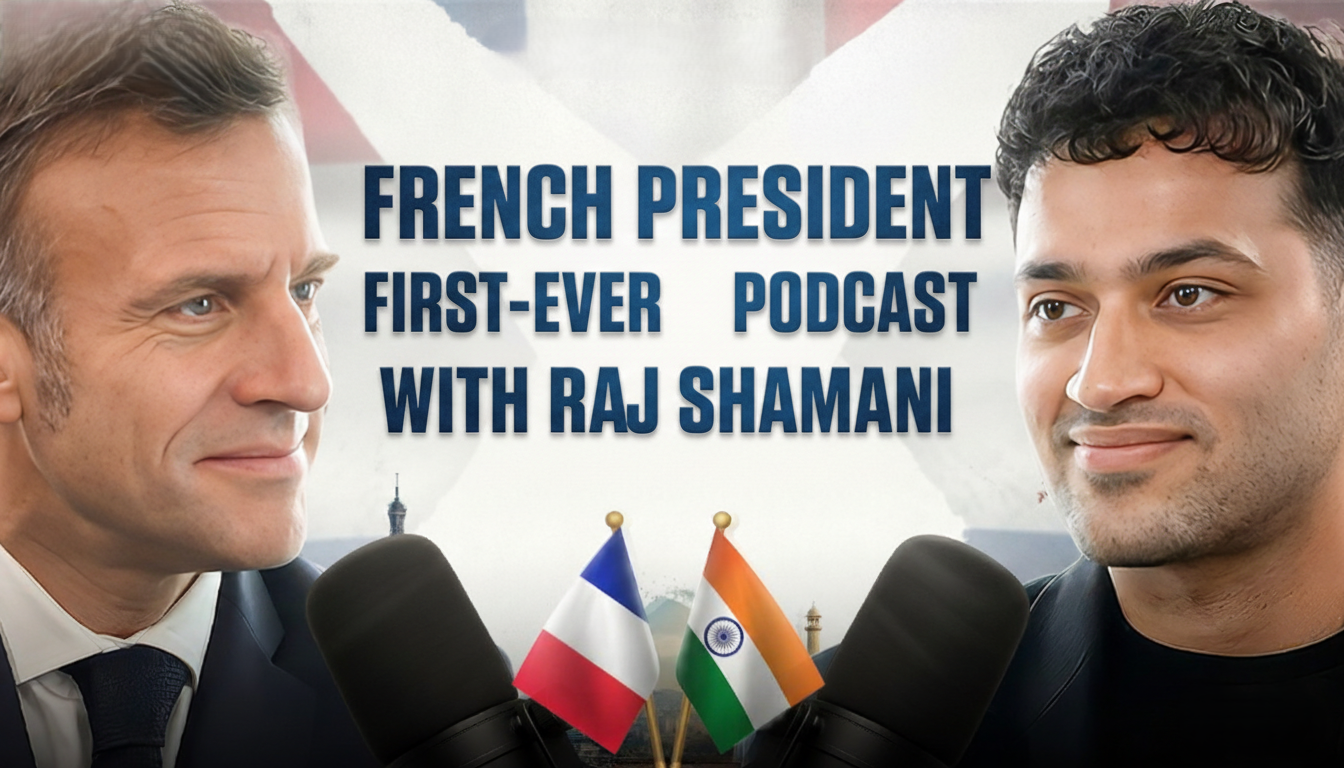
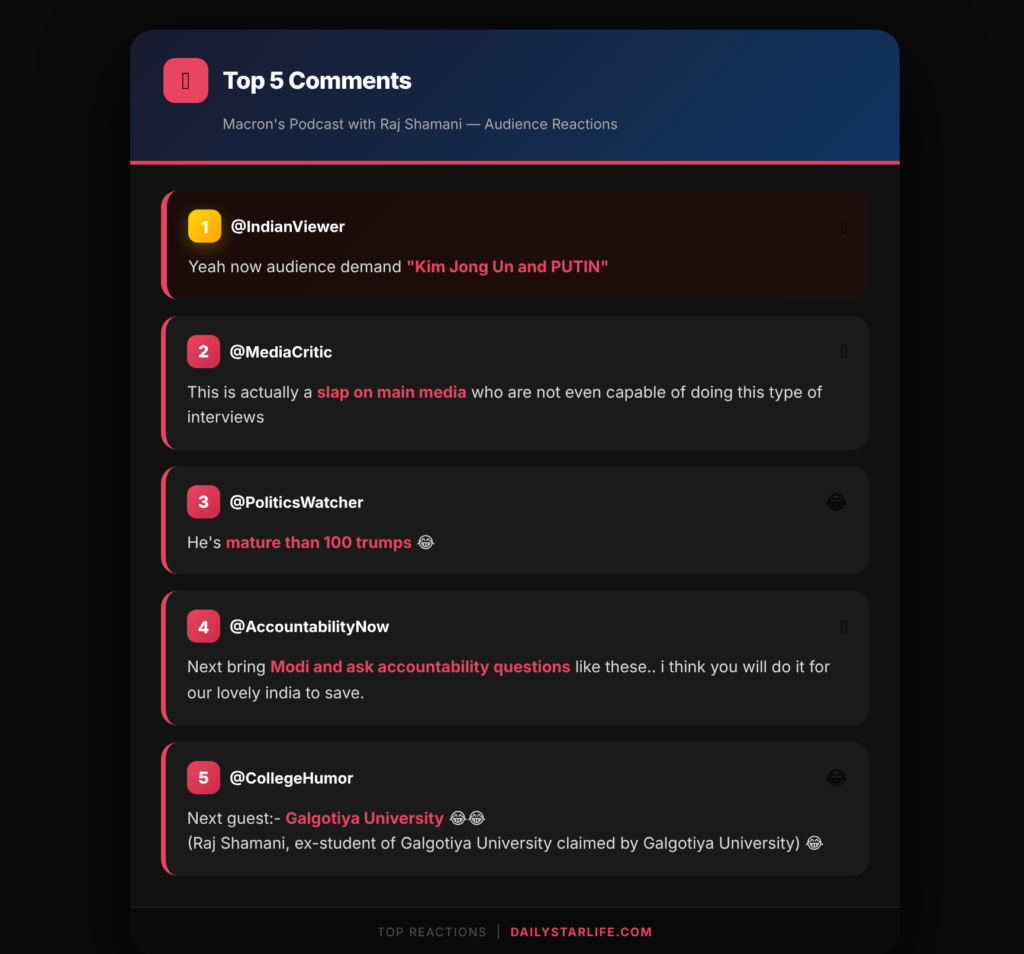
French President Emmanuel Macron recently made headlines by appearing on his first-ever global podcast, choosing to sit down with 28-year-old Indian creator Raj Shamani in Mumbai. The decision to bypass traditional news networks in favor of a youth-focused podcast signals a major shift in how world leaders engage with India’s digital-first generation.
Before the interview, Macron surprised many by taking an unscripted morning jog through Mumbai’s busy streets, drawing praise on social media for his simplicity and down-to-earth approach. The images stood in sharp contrast to the heavy security protocols typically associated with visits by world leaders.
Shamani thanked President Macron for choosing to do the show with him, marking a significant moment for Indian content creators on the global stage.
Why This Interview Matters Now
Macron’s appearance on an Indian podcast is a clear acknowledgment that traditional geopolitical alliances are shifting. During the conversation, he specifically highlighted India’s massive engineering talent pool, noting that the country trains more engineers annually than the United States and Europe combined.
France has historically had strong scientific capabilities but lacked the scale and capital to compete with American and Chinese tech companies. Macron sees India’s young workforce as critical to Europe’s future in technology. He announced plans to triple the number of Indian students studying in France, aiming for 30,000 students as part of building a deeper talent pipeline between the two countries.
France’s €109 Billion AI Bet
A significant portion of the podcast focused on technology and artificial intelligence. France recently announced a massive €109 billion investment in AI infrastructure. However, half of that funding is coming from the UAE, and much of the core technology is American.
Macron acknowledged that the tech market is currently dominated by US companies in a “winner takes all” scenario. Rather than simply buying software licenses and losing control of data, France is taking a different approach. By using Gulf investment to build physical data centers on French soil, the country ensures that all operations must follow strict European data protection regulations.
More importantly, this strategy forces foreign tech giants to transfer technological knowledge to local French companies. Macron specifically mentioned Mistral, a French open-source AI company, as part of his vision to eventually compete with American large language models.
Looking further ahead, Macron positioned quantum computing as France’s major technological moonshot for 2035, leveraging the country’s deep expertise in mathematics to potentially leapfrog the current AI race entirely.
The Trump Factor
The conversation inevitably touched on France’s complicated relationship with the United States. Raj Shamani pointed out that former President Donald Trump recently shared Macron’s private messages publicly and threatened France with 200% tariffs.
Macron’s response was measured but clear. He said “respect is part of leadership” and warned against leaders “going backward” into disrespect and violence. The statement was a pointed criticism without directly attacking Trump by name.
This tension directly drives Macron’s push for what he calls “strategic autonomy.” He praised India and Prime Minister Modi for demonstrating that this approach works. India has maintained strong relationships with the United States, honored its historical friendship with Russia, and partnered with France—all without becoming dependent on any single country.
Macron is trying to convince Europe to adopt this same model: remain allied with the US but not fundamentally dependent on it for technology or defense.
Warning About Global Security
The most serious part of the interview dealt with Russia’s invasion of Ukraine and what it means for global security. Macron described it as a “19th-century war” of territorial expansion, made dangerous by the fact that Russia is a UN Security Council member with nuclear weapons.
He warned that the world is entering “uncharted territories” where international law is being replaced by the “order of the strongest.” Macron noted he has roughly 15 months left in his term to make France a credible player in the coming defense race while trying to establish new international frameworks for arms control.
If these efforts fail, he suggested the world faces a volatile decade where the established rules of the UN Charter no longer apply.
My Opinion
Macron’s decision to appear on Raj Shamani’s podcast was far more than a casual media appearance. It represents a deliberate strategy to speak directly to India’s young, digitally-connected population while building strategic partnerships that could define the next decade of global relations.
By choosing Mumbai over traditional media capitals and a 28-year-old podcaster over established journalists, Macron sent a clear message: France sees India as a critical partner for its technological and geopolitical future. The jogging photos and casual conversation style masked a highly calculated diplomatic move designed to position both countries as independent powers in an increasingly fractured world order.
As traditional alliances weaken and new technological battlegrounds emerge, one question looms large: Can middle powers like France and India successfully forge their own path, or will they ultimately be forced to choose sides in the coming struggle between Washington and Beijing?